


 Cart
Cart
 sales@molnova.com



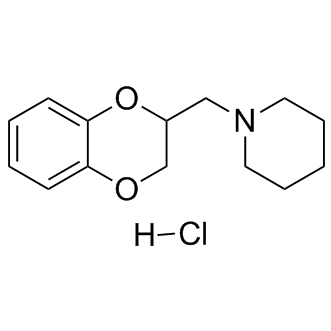
Piperoxan hydrochloride
CAS No. 135-87-5
Piperoxan hydrochloride( F 933 | 933F | Benodaine )
Catalog No. M11473 CAS No. 135-87-5
An α-adrenergic blocking agent and antihistamine; also antagonizes histamine-induced bronchospasm in vivo.
Purity : >98% (HPLC)
 COA
Datasheet
HNMR
HPLC
MSDS
Handing Instructions
COA
Datasheet
HNMR
HPLC
MSDS
Handing Instructions
| Size | Price / USD | Stock | Quantity |
| 2MG | 53 | In Stock |


|
| 5MG | 110 | In Stock |
|
| 10MG | 178 | In Stock |
|
| 25MG | 259 | In Stock |
|
| 50MG | 332 | In Stock |
|
| 100MG | 405 | In Stock |
|
| 200MG | Get Quote | In Stock |
|
| 500MG | Get Quote | In Stock |
|
| 1G | Get Quote | In Stock |
|
Biological Information
-
Product NamePiperoxan hydrochloride
-
NoteResearch use only, not for human use.
-
Brief DescriptionAn α-adrenergic blocking agent and antihistamine; also antagonizes histamine-induced bronchospasm in vivo.
-
DescriptionAn α-adrenergic blocking agent and antihistamine; also antagonizes histamine-induced bronchospasm in vivo.
-
In VitroWhen the medulla is superfused with α2 adrenoceptor antagonist Piperoxane (50 μM; 5 min) while the pons is with artificial cerebrospinal fluid (ACSF), the three inactive preparations display rhythmic phrenic bursts at a low frequency (2-4 c/min), and the phrenic burst frequency of the 12 active ones significantly increases during the last 3 min of Piperoxane applications (163±12% of the previous mean frequency). In active medullary preparations, the effects of NA applications (25 μM; 5 min) are compared when the preparations sre superfused either by ACSF (n=8) or by the α2 adrenoceptor antagonist Piperoxane (50 μM; PIP-ACSF; n=5). NA applications either alone (NA-ACSF) or with Piperoxane (PIP-ACSF+NA) significantly increases the phrenic burst frequency. However, the blockage of the medullary α2 adrenoceptors by Piperoxane potentiates a phrenic burst frequency increase: during the fifth minute of NA applications, the phrenic burst frequency reached 171±11% of the mean control value when ACSF is applied alone and 234±21% of the mean control value when PIP-ACSF is applied in control condition.
-
In Vivo——
-
SynonymsF 933 | 933F | Benodaine
-
PathwayAngiogenesis
-
TargetAdrenergic Receptor
-
Recptorα2 receptor
-
Research AreaInflammation/Immunology
-
Indication——
Chemical Information
-
CAS Number135-87-5
-
Formula Weight269.7671
-
Molecular FormulaC14H20ClNO2
-
Purity>98% (HPLC)
-
SolubilityDMSO: ≥ 31mg/mL
-
SMILESC1CCN(CC1)CC2COC3=CC=CC=C3O2.Cl
-
Chemical NamePiperidine, 1-[(2,3-dihydro-1,4-benzodioxin-2-yl)methyl]-, hydrochloride (1:1)
Shipping & Storage Information
-
Storage(-20℃)
-
ShippingWith Ice Pack
-
Stability≥ 2 years
Reference
1. Nomura Y, et al. Br J Pharmacol. 1979 Aug;66(4):531-5.
2. BURNSTOCK G. Br J Pharmacol Chemother. 1958 Sep;13(3):216-26.
molnova catalog



related products
-
Astragalus polypheno...
Astragalus polyphenols is a compound isolated from the roots of Polygonum species, inhibits the formation of 5-HETE, HHT and thromboxane B2.
-
Lutein
Lutein has antitumour action, is potentially useful for treating macular degeneration.
-
Dexmedetomidine hydr...
An agonist of α2-adrenergic receptor that used in veterinary medicine for its analgesic and sedative properties.
